

Part II of a three-part series examining the modern resurgence of baton twirling, the urgent need to preserve its history, and the launch of the Baton Twirling Preservation Society. Click here to read Part I.
Modern baton twirling did not appear in isolation. Today’s collegiate athletes, viral performers, and international champions are part of a much larger historical continuum shaped by decades of regional traditions, evolving performance styles, youth culture, and community organizations that once existed in nearly every corner of America.
Yet much of that history now stands at risk of disappearing.
The Civic Infrastructure That Built Twirling
It is worth asking: Where would baton twirling be without the VFW, the American Legion, the Elks, the Lions Clubs, and countless local civic organizations?
For decades, these groups formed the financial lifeblood and structural backbone of the activity. While VFW posts and Legion halls often supported drum and baton corps and major national contests, local civic clubs funded hometown parade lines, purchased uniforms, sponsored competitions, and created the local programs that first placed batons into children’s hands.
In addition to producing champions, this civic ecosystem cultivated an enormous network of instructors, volunteers, judges, parade organizers, and studio owners who passed the tradition from one generation to the next. In that regard, the modern athletic era of baton twirling stands upon foundations built largely through volunteerism, civic pride, and community investment.
The Disappearance of Living Memory
Many of the people who built those foundations are now gone.
Countless twirling heroes, both famous and unknown, have died without their stories ever being formally documented. Two generations that had profound impacts on baton twirling, the Lost Generation and the Greatest Generation, have already passed away.
The Silent Generation: The Architects of Modern Baton Twirling
There are approximately 13 million members of the Silent Generation still remaining. Born between 1925 and 1945, they were the men and women who transformed baton twirling into a recognizable American institution.
Before World War II, twirling certainly existed, but was tied to military mace-bearing traditions, vaudeville performance, circus arts and a relatively small number of collegiate drum majors and majorettes. During the war years and especially the late 1940s and 1950s, baton twirling became mainstream. Small-town America suddenly had majorette lines, parade corps, baton schools and local competitions.
The Silent Generation, which is currently between 80 and 97 years of age, produced many of the foundational baton teachers who later instructed Baby Boomers (born between 1946 and 1960) and Generation X (born between 1961 and 1981). They built the first large twirling schools, wrote instruction books, organized competitions, sewed uniforms, directed parade groups, and established many of the traditions still associated with baton culture today.
In many ways, they were the architects of modern American baton twirling. And, they are dying at a rate of 7,000 to10,000 per day. With them disappear countless undocumented local histories, photographs, traditions, and memories tied to twentieth-century baton twirling culture.
Baby Boomers
Baby Boomers were the first students of Silent Generation coaches. For this generation, baton lessons were a common part of childhood. As they graduated to coaching, they played a pivotal role in supporting national organizations, creating competitions, defining instructional systems, and launching twirling businesses. They also created much of the surviving photographic and cultural records of baton twirling’s twentieth-century peak.
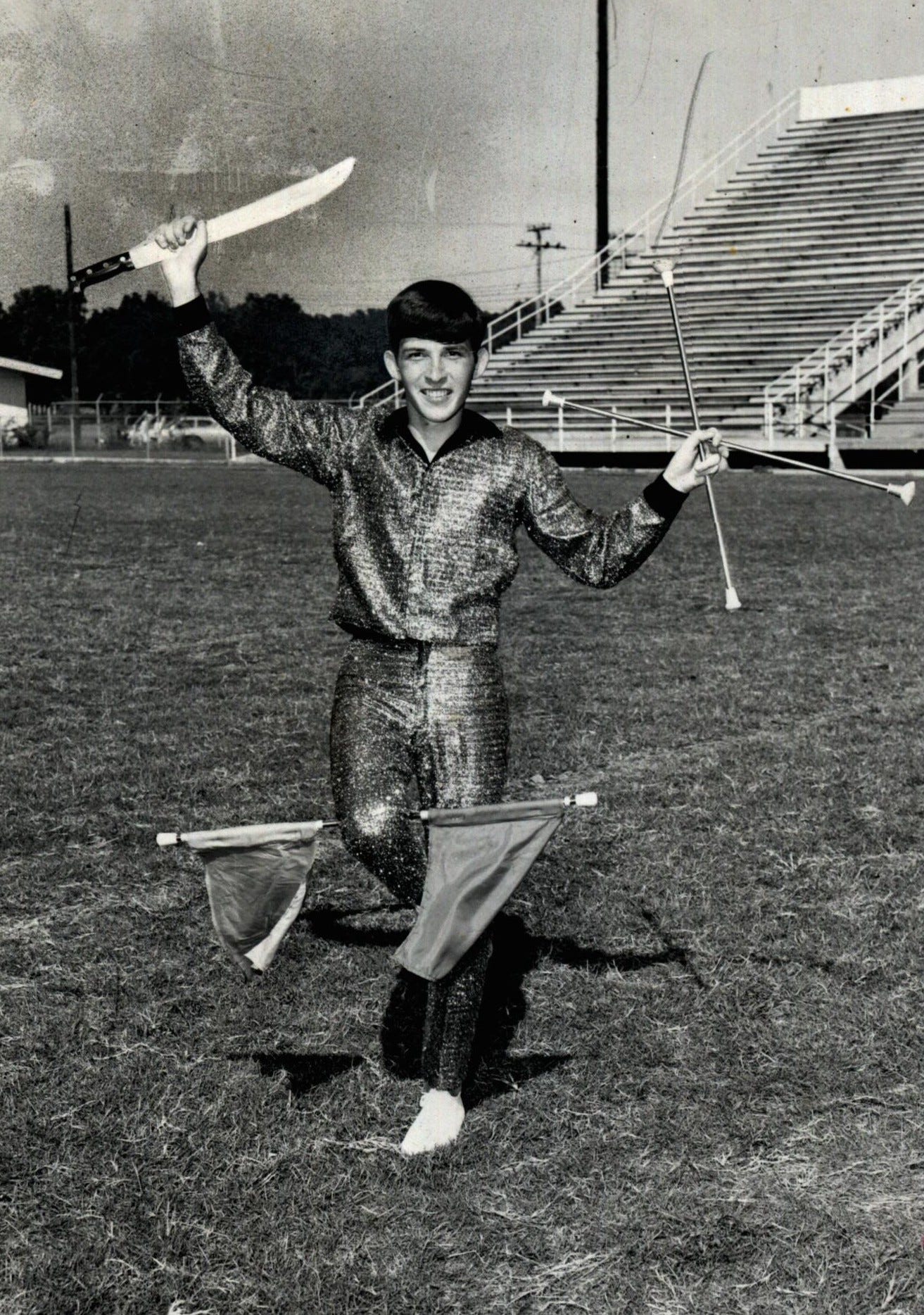
Approximately 6,000 to 7,000 Baby Boomers die every day in the United States, and this loss, like the loss of the Silents, is incalculable. Much of baton twirling’s activities have not been archived.
Twirling history often lived in scrapbooks, local newspaper clippings, fading photographs, parade programs, trophies, and oral storytelling passed quietly between generations. Many of the people who helped build the activity never viewed themselves as historically important. They were local majorettes, corps directors, instructors, drum majors, judges, volunteers, and parade organizers simply contributing to their communities.
Many of the people who helped build the activity never viewed themselves as historically important.
As Silents and Boomers pass away, enormous pieces of twirling history disappear with them. Does the name Doris Wheelus ring a bell? Probably not. But Wheelus, who is in her late 80s and still living in Northeast Oklahoma, was a pioneer of adaptive twirling. A kind and much-beloved instructor, she went to great lengths to teach twirling to deaf students and students with prosthetics. Her work inspired others in Oklahoma to teach gymnastics to deaf students. Her legacy lives on but largely unknown.
When history is not recorded, entire worlds disappear. Corps and studios are forgotten. Names are lost. Photographs become unidentified. Once-famous local performers vanish from public memory altogether.
What remains is often fragmented and scattered across attics, basements, family albums, storage units, and small-town newspaper archives.
The Fragility of Twirling Archives
Even formal preservation efforts have sometimes become vulnerable to time.
The late Don Sartell, founder of the National Baton Twirling Association, also established the National Twirling Museum. By many accounts, the collection was substantial. According to his obituary, portions of the museum’s contents were donated to a historical society in Sartell’s hometown of Janesville, Wisconsin. The current status, accessibility, condition or plans for the archive have not, to our knowledge, been discussed publicly.
This uncertainty illustrates a broader problem facing many niche cultural activities. Without organized and sustained preservation, history becomes fragile.
Uniforms deteriorate. Film reels decay. Scrapbooks are discarded during estate cleanouts. Trophy collections are separated from the stories that once gave them meaning. Entire local traditions can disappear within a single generation.
To Twirling’s credit, many Facebook groups have been created to celebrate and preserve twirling memories, photographs, and history. Unfortunately, these digital communities are vulnerable. At any time they could be hacked, removed by Facebook or the owners could die before sharing administrative privileges.
More Than Nostalgia
The loss of twirling history matters because baton twirling was never merely an extracurricular activity. For many participants, twirling shaped identity, discipline, confidence, leadership, performance under pressure, and lifelong friendships. It created opportunities for travel, scholarship, public performance, and community involvement. For others, it represented one of the few highly visible artistic and athletic outlets available to young men and women during earlier eras of American life.
Baton twirling also occupies a unique place within American cultural history.
It intersects with marching bands, military traditions, civic parades, popular entertainment, youth organizations, history, regional culture, dance, athletics, and performance art. Twirling reflects changing ideas about femininity, athleticism, patriotism, spectacle, and community identity across generations.
Yet despite this cultural significance, much of the activity’s history remains undocumented.
Without preservation, future generations may see only isolated moments: a viral toss, a glittering costume, a halftime routine, or a nostalgic parade photograph disconnected from the deeper history behind it.
Quiet Urgency
There is a quiet urgency to preservation work.
Baton twirling still possesses strong oral traditions, which is remarkable. Stories continue to survive through former athletes, coaches, parents, judges, and local communities. But oral history alone cannot fully protect a cultural tradition from disappearance.
If stories are not documented now, many will be lost forever. Many have already been lost…
This urgency is part of what inspired the creation of the Baton Twirling Preservation Society and the expansion of The Vintage Twirler archive project.
Preservation does not mean resisting change or longing for a return to the past. It means recognizing the generations of athletes, majorettes, instructors, drum majors, corps members, and performers who built the foundation upon which today’s modern sport stands. Unfortunately, once living memory disappears, recovery becomes very, very difficult.
Part III: Building the Baton Twirling Preservation Society
Come back tomorrow for Part III of a three-part series examining the modern resurgence of baton twirling, the urgent need to preserve its history, and the launch of the Baton Twirling Preservation Society.
I have one of those scrapbooks stored in a basement. Is there a way to submit the news articles and pictures?